






กิจกรรมคณะ
19 ก.ย. 2569

Loading...
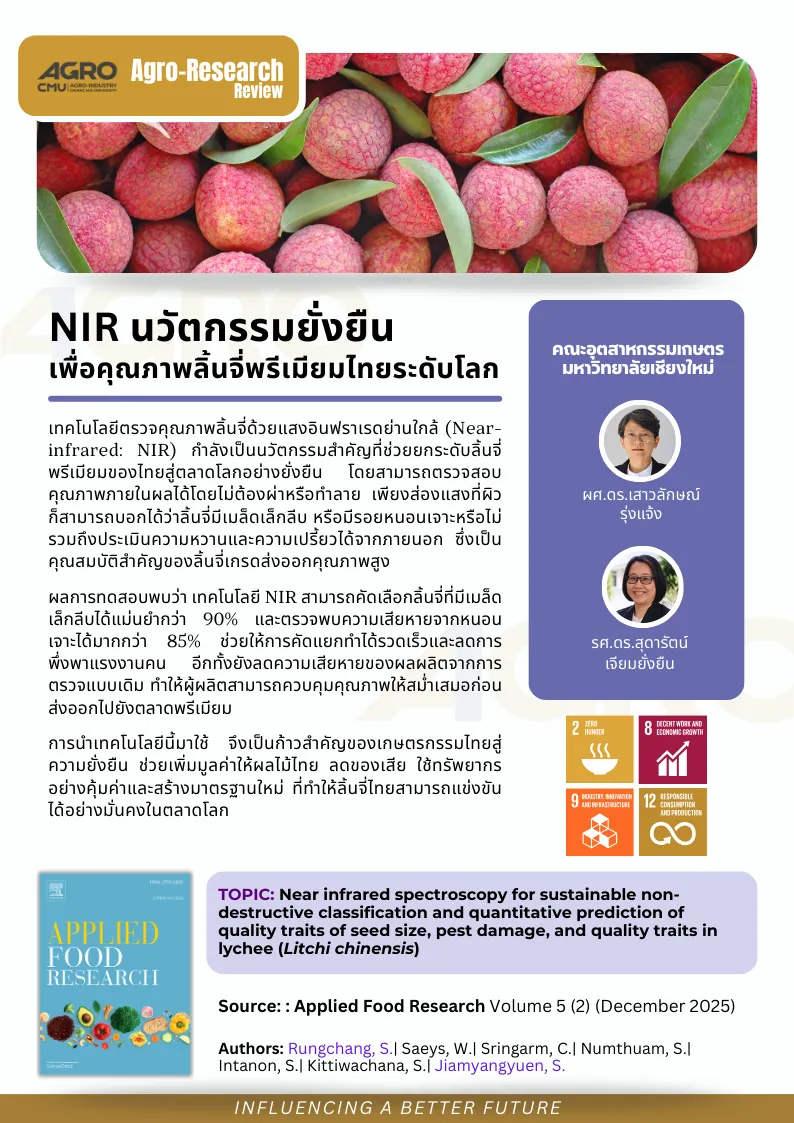
เทคโนโลยีตรวจคุณภาพลิ้นจี่ด้วยแสงอินฟราเรดย่านใกล้ (Near-infrared: NIR) กำลังเป็นนวัตกรรมสำคัญที่ช่วยยกระดับลิ้นจี่ พรีเมียมของไทยสู่ตลาดโลกอย่างยั่งยืน โดยสามารถตรวจสอบคุณภาพภายในผลได้โดยไม่ต้องผ่าหรือทำลาย เพียงส่องแสงที่ผิวก็สามารถบอกได้ว่าลิ้นจี่มีเมล็ดเล็กลีบ มีรอยหนอนเจาะหรือไม่ รวมถึงประเมินความหวานและความเปรี้ยวได้จากภายนอก ซึ่งเป็นคุณสมบัติสำคัญของลิ้นจี่เกรดส่งออกคุณภาพสูง
ผลการทดสอบพบว่าเทคโนโลยี NIR สามารถคัดเลือกลิ้นจี่ที่มีเมล็ดเล็กหรือเมล็ดลีบได้แม่นยำกว่า 90% และตรวจพบความเสียหายจากหนอนเจาะได้มากกว่า 85% ช่วยให้การคัดแยกทำได้รวดเร็วและลดการพึ่งพาแรงงานคน อีกทั้งยังลดความเสียหายของผลผลิตจากการตรวจแบบเดิม ทำให้ผู้ผลิตสามารถควบคุมคุณภาพให้สม่ำเสมอก่อนส่งออกไปยังตลาดพรีเมียมทั่วโลก
การนำเทคโนโลยีนี้มาใช้จึงเป็นก้าวสำคัญของเกษตรกรรมไทยสู่ความยั่งยืน ช่วยเพิ่มมูลค่าให้ผลไม้ไทย ลดของเสีย ใช้ทรัพยากรอย่างคุ้มค่า และสร้างมาตรฐานใหม่ที่ทำให้ลิ้นจี่ไทยสามารถแข่งขันได้อย่างมั่นคงในตลาดโลก
Topic: Near infrared spectroscopy for sustainable non-destructive classification and quantitative prediction of quality traits of seed size, pest damage, and quality traits in lychee (Litchi chinensis)
Authors: Rungchang, S.| Saeys, W.| Sringarm, C.| Numthuam, S.| Intanon, S.| Kittiwachana, S.| Jiamyangyuen, S.
Abstract:
Lychees are highly valued in export markets if they have an aborted seed and are free from fruit borer damage. However, the traditional grading method relies on manual assessment by laborers, which is experience-dependent, time-consuming, and potentially destructive to the fruit. The objective of this study was to evaluate NIR spectroscopy for classifying premium lychee fruits based on seed size and the absence of fruit borer damage, as well as for quantifying the soluble solids content (SSC) and titratable acidity (TA). NIR spectra in the 12,000–4000 cm⁻¹ range were acquired in reflectance mode at three different positions: stem end, cheek side, and tip. The classification models effectively distinguished seed size at tip side, achieving 90.58 % accuracy and fruit borer damage at stem-end, resulting in 85.71 % and 90.91 % correct classification for normal and aborted seeds, respectively. Additionally, SSC and TA content were quantitatively assessed from the NIR spectra with R2 values > 0.90. These results could pave the way for efficient quality control of lychees. This research advances innovative sensing technologies for agriculture while enabling sustainable production and resource-efficient food systems.
Source: Applied Food Research Volume 5 (2) (December 2025)
Keywords: Fruit physiology; Postharvest grading; Quality assessment; Chemometrics; NIR spectroscopy
View at publisher: https://www.sciencedirect.com/science/article/pii/S2772502225008571?via%3Dihub