






กิจกรรมคณะ
19 ก.ย. 2569

Loading...
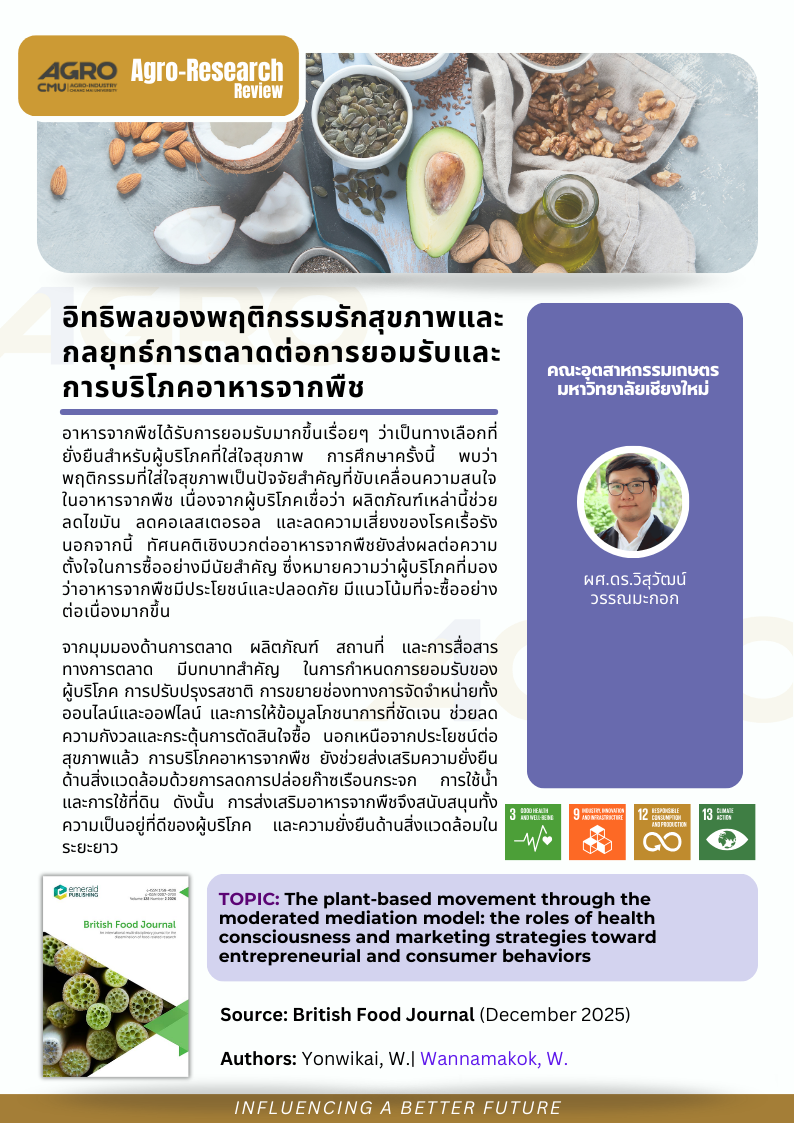
อาหารจากพืชได้รับการยอมรับมากขึ้นเรื่อยๆ ว่าเป็นทางเลือกที่ยั่งยืนสำหรับผู้บริโภคที่ใส่ใจสุขภาพ การศึกษาครั้งนี้พบว่าพฤติกรรมที่ใส่ใจสุขภาพเป็นปัจจัยสำคัญที่ขับเคลื่อนความสนใจในอาหารจากพืช เนื่องจากผู้บริโภคเชื่อว่าผลิตภัณฑ์เหล่านี้ช่วยลดไขมัน ลดคอเลสเตอรอล และลดความเสี่ยงของโรคเรื้อรัง นอกจากนี้ ทัศนคติเชิงบวกต่ออาหารจากพืชยังส่งผลต่อความตั้งใจในการซื้ออย่างมีนัยสำคัญ ซึ่งหมายความว่าผู้บริโภคที่มองว่าอาหารจากพืชมีประโยชน์และปลอดภัยมีแนวโน้มที่จะซื้ออย่างต่อเนื่องมากขึ้น
จากมุมมองด้านการตลาด ผลิตภัณฑ์ สถานที่ และการสื่อสารทางการตลาดมีบทบาทสำคัญในการกำหนดการยอมรับของผู้บริโภค การปรับปรุงรสชาติ การขยายช่องทางการจัดจำหน่ายทั้งออนไลน์และออฟไลน์ และการให้ข้อมูลโภชนาการที่ชัดเจน ช่วยลดความกังวลและกระตุ้นการตัดสินใจซื้อ นอกเหนือจากประโยชน์ต่อสุขภาพแล้ว การบริโภคอาหารจากพืชยังช่วยส่งเสริมความยั่งยืนด้านสิ่งแวดล้อมด้วยการลดการปล่อยก๊าซเรือนกระจก การใช้น้ำ และการใช้ที่ดิน ดังนั้น การส่งเสริมอาหารจากพืชจึงสนับสนุนทั้งความเป็นอยู่ที่ดีของผู้บริโภคและความยั่งยืนด้านสิ่งแวดล้อมในระยะยาว
Topic: The plant-based movement through the moderated mediation model: the roles of health consciousness and marketing strategies toward entrepreneurial and consumer behaviors
Authors: Yonwikai, W.| Wannamakok, W.
Abstract:
Purpose – This study investigates the dynamic interplay between health-conscious behaviors, attitudes toward plant-based foods and consumers’ purchasing decisions, incorporating perspectives from both end consumers and entrepreneurial stakeholders. Through the integration of quantitative analyses derived from structured consumer survey data and qualitative insights obtained from industry practitioners, the research provides a nuanced understanding of the mechanisms through which individual health motivations are translated into behavioral intentions.
Design/methodology/approach – Using a convergent parallel mixed-methods design, quantitative data from 422 consumers were analyzed using partial least squares and Macro Process Model 15. Also, the qualitative insights were gathered from eight plant-based food entrepreneurs for further investigation.
Findings – The study reveals that preventing noncommunicable diseases (NCDs) is a key motivator for plantbased food consumption. Health-conscious behavior significantly influences attitudes and purchase intentions, with attitudes acting as a mediating factor. Product, place and promotional strategies strengthen these relationships, while price has no significant influence on plant-based food products’ purchasing intentions.
Research limitations/implications – This research introduces the theoretical implications of the SAVE framework, which encompasses strategic marketing, attitude shaping, value-driven health positioning and enhancing purchase intention, providing a novel conceptual lens for examining and leveraging health-conscious consumer behavior within the plant-based food market in the nearest future.
Practical implications – The findings offer actionable guidance for marketers and businesses aiming to engage health-conscious consumers, emphasizing the importance of non-price marketing mix elements and attitudeshaping strategies to promote plant-based dietary practices.
Originality/value – This study advances the understanding of the key factors that consumers perceive as determinants of their purchasing intentions toward plant-based food products.
Source: British Food Journal, (December 2025)
Keywords: Convergent parallel mixed method; Healthy behavior; Plant-based food; Marketing strategy; Consumer behavior
View at publisher: https://doi.org/10.1108/BFJ-05-2025-0732