








ยกระดับสุขภาพด้วยเครื่องดื่มหมักจากสาหร่ายพวงองุ่นและเนื้อเปลือกเชอร์รี่กาแฟ
วิจัย
9 มี.ค. 2569
ผู้เขียน: nutthawat.s@cmu.ac.th
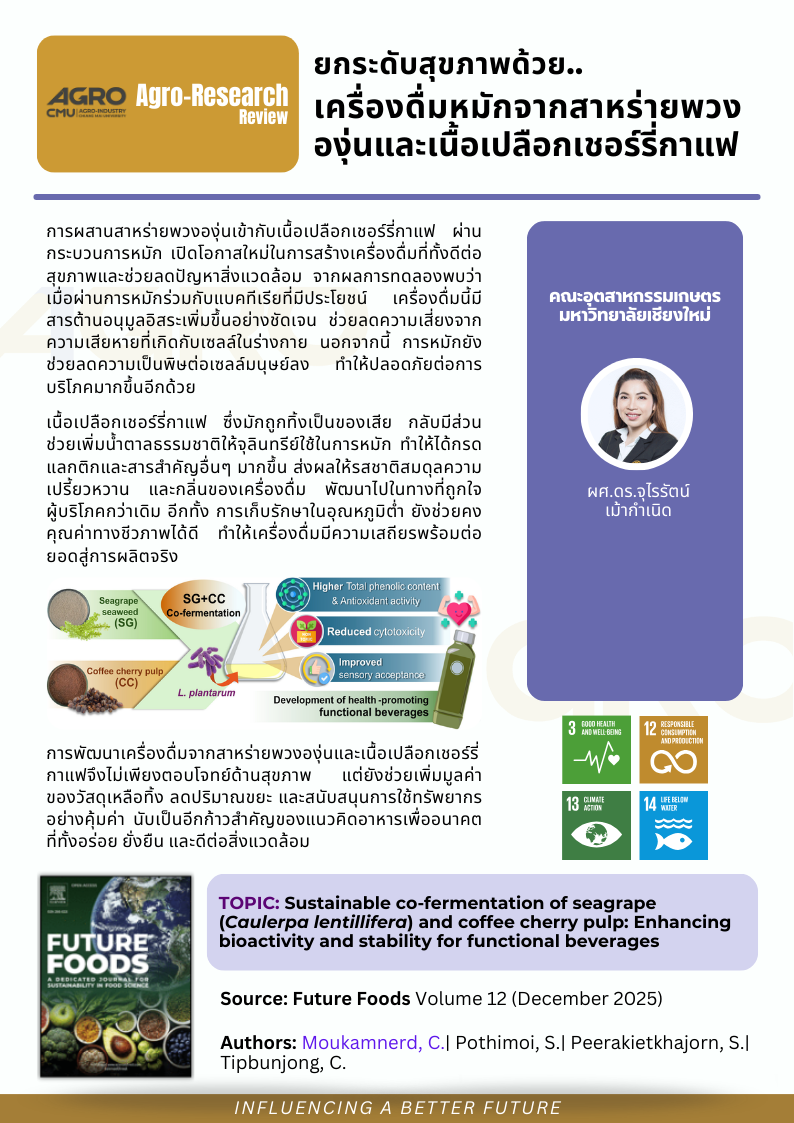
การผสานสาหร่ายพวงองุ่นเข้ากับเนื้อเปลือกเชอร์รี่กาแฟผ่านกระบวนการหมัก เปิดโอกาสใหม่ในการสร้างเครื่องดื่มที่ทั้งดีต่อสุขภาพและช่วยลดปัญหาสิ่งแวดล้อม จากผลการทดลองพบว่า เมื่อผ่านการหมักร่วมกับแบคทีเรียที่มีประโยชน์ เครื่องดื่มนี้มีสารต้านอนุมูลอิสระเพิ่มขึ้นอย่างชัดเจน ช่วยลดความเสี่ยงจากความเสียหายที่เกิดกับเซลล์ในร่างกาย นอกจากนี้ การหมักยังช่วยลดความเป็นพิษต่อเซลล์มนุษย์ลง ทำให้ปลอดภัยต่อการบริโภคมากขึ้นอีกด้วย
เนื้อเปลือกเชอร์รี่กาแฟซึ่งมักถูกทิ้งเป็นของเสีย กลับมีส่วนช่วยเพิ่มน้ำตาลธรรมชาติให้จุลินทรีย์ใช้ในการหมัก ทำให้ได้กรดแลกติกและสารสำคัญอื่น ๆ มากขึ้น ส่งผลให้รสชาติ สมดุลความเปรี้ยวหวาน และกลิ่นของเครื่องดื่มพัฒนาไปในทางที่ถูกใจผู้บริโภคกว่าเดิม อีกทั้งการเก็บรักษาในอุณหภูมิต่ำยังช่วยคงคุณค่าทางชีวภาพได้ดี ทำให้เครื่องดื่มมีความเสถียรพร้อมต่อยอดสู่การผลิตจริง
การพัฒนาเครื่องดื่มจากสาหร่ายพวงองุ่นและเนื้อเปลือกเชอร์รี่กาแฟจึงไม่เพียงตอบโจทย์ด้านสุขภาพ แต่ยังช่วยเพิ่มมูลค่าของวัสดุเหลือทิ้ง ลดปริมาณขยะ และสนับสนุนการใช้ทรัพยากรอย่างคุ้มค่า นับเป็นอีกก้าวสำคัญของแนวคิดอาหารเพื่ออนาคตที่ทั้งอร่อย ยั่งยืน และดีต่อสิ่งแวดล้อม
Topic: Sustainable co-fermentation of seagrape (Caulerpa lentillifera) and coffee cherry pulp: Enhancing bioactivity and stability for functional beverages
Authors: Moukamnerd, C.| Pothimoi, S.| Peerakietkhajorn, S.| Tipbunjong, C.
Abstract:
Fermentation of seagrape seaweed (Caulerpa lentillifera) with Lactiplantibacillus plantarum and supplemented with coffee cherry pulp enhances microbial viability, bioactive compound content, and antioxidant activity while reducing cytotoxicity and improving sensory acceptance. The co-fermented formulation containing 50 g/L seagrape, 25 g/L coffee cherry pulp, L. plantarum TISTR 2070, and 30 g/L sucrose exhibited the highest total phenolic content and antioxidant capacity, with DPPH, FRAP, and ABTS values significantly exceeding those of the unfermented control (p ≤ 0.05). Cold storage at 4 °C demonstrated that the fermented beverage retained its antioxidant properties and maintained microbial viability with minor changes in sugar content and pH. Additionally, cytotoxicity testing on human colon cells demonstrated that fermentation markedly reduced cytotoxicity, with the CC50 increasing from 16,020 ± 445.6 µg/mL (unfermented SG) to 25,860 ± 336.6 µg/mL in the co-fermented sample (p ≤ 0.05), indicating improved safety for human consumption. Sensory evaluation confirmed that the fermented beverage was more accepted than the unfermented counterpart, with improvements in taste, mouthfeel, and overall preference. Multivariate analysis by PCA further revealed strong correlations between microbial activity, antioxidant capacity, and sensory attributes. LC-QTOF-MS analysis confirmed the release and biotransformation of diverse bioactive metabolites during fermentation, contributing to the enhanced functional properties of the final product. With its enhanced bioactivity, stability, reduced cytotoxicity, and superior sensory attributes, co-fermentation of seagrape and coffee cherry pulp presents a promising strategy for the development of health-promoting functional beverages.
Source: Future Foods. Volume 12 (December 2025)
Keywords: Caulerpa lentillifera; Coffee cherry pulp; Lactiplantibacillus plantarum; Functional beverage; Antioxidant activity; Bioactive compounds; Zero waste fermentation
View at publisher: https://www.sciencedirect.com/science/article/pii/S2666833525001509
ข่าวล่าสุด
 รางวัลและผลงาน27 ส.ค. 2569
 วิจัย27 ส.ค. 2569
 รางวัลและผลงาน27 ส.ค. 2569


- ประกวดราคา25 ส.ค. 2569