







เทคโนโลยีพลาสมาเย็น: นวัตกรรมที่ช่วยรักษาสารสำคัญในอัญชันโดยไม่ใช้ความร้อน
วิจัย
21 ก.ย. 2569
ผู้เขียน: nutthawat.s@cmu.ac.th
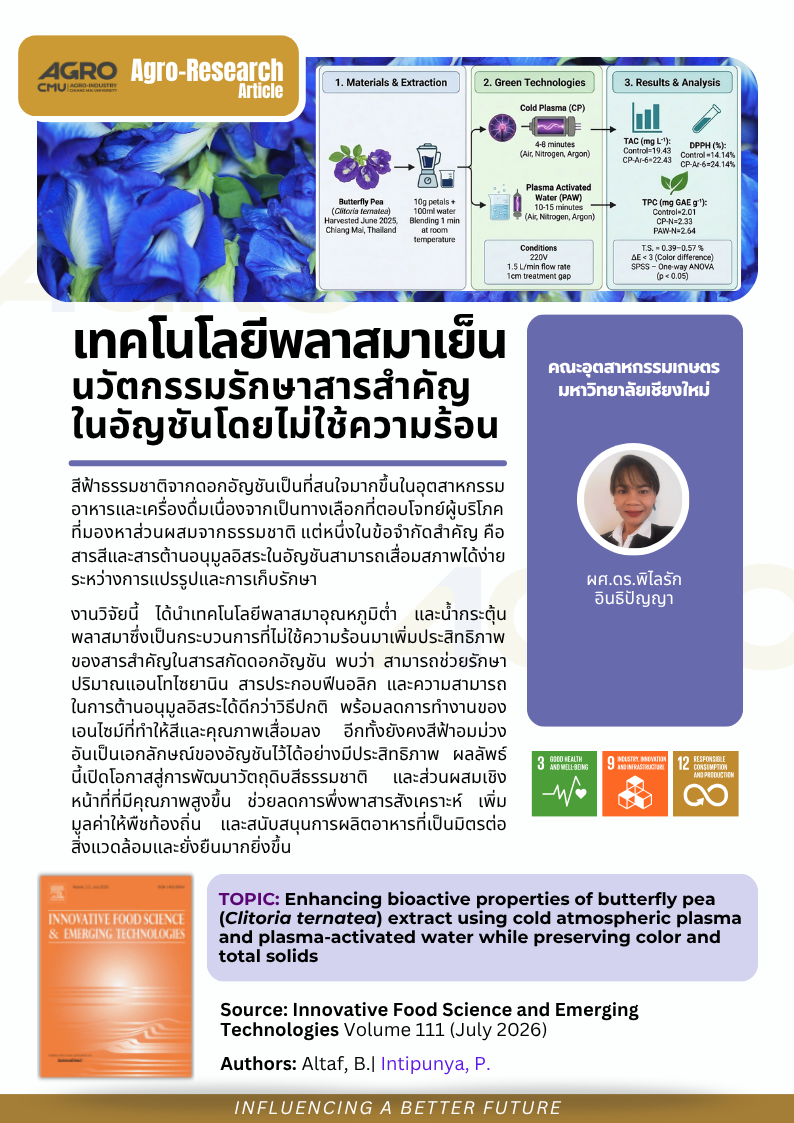
สีฟ้าธรรมชาติจากดอกอัญชันเป็นที่สนใจมากขึ้นในอุตสาหกรรมอาหารและเครื่องดื่ม เนื่องจากเป็นทางเลือกที่ตอบโจทย์ผู้บริโภคที่มองหาส่วนผสมจากธรรมชาติ แต่หนึ่งในข้อจำกัดสำคัญคือสารสีและสารต้านอนุมูลอิสระในอัญชันสามารถเสื่อมสภาพได้ง่ายระหว่างการแปรรูปและการเก็บรักษา งานนี้ได้นำเทคโนโลยีพลาสมาอุณหภูมิต่ำและน้ำกระตุ้นพลาสมา ซึ่งเป็นกระบวนการที่ไม่ใช้ความร้อน มาเพิ่มประสิทธิภาพของสารสำคัญในสารสกัดดอกอัญชัน พบว่าสามารถช่วยรักษาปริมาณแอนโทไซยานิน สารประกอบฟีนอลิก และความสามารถในการต้านอนุมูลอิสระได้ดีกว่าวิธีปกติ พร้อมลดการทำงานของเอนไซม์ที่ทำให้สีและคุณภาพเสื่อมลง อีกทั้งยังคงสีฟ้าอมม่วงอันเป็นเอกลักษณ์ของอัญชันไว้ได้อย่างมีประสิทธิภาพ ผลลัพธ์นี้เปิดโอกาสสู่การพัฒนาวัตถุดิบสีธรรมชาติและส่วนผสมเชิงหน้าที่ที่มีคุณภาพสูงขึ้น ช่วยลดการพึ่งพาสารสังเคราะห์ เพิ่มมูลค่าให้พืชท้องถิ่น และสนับสนุนการผลิตอาหารที่เป็นมิตรต่อสิ่งแวดล้อมและยั่งยืนมากยิ่งขึ้น
Topic: Enhancing bioactive properties of butterfly pea (Clitoria ternatea) extract using cold atmospheric plasma and plasma-activated water while preserving color and total solids
Authors: Altaf, B.| Intipunya, P.
Abstract:
Butterfly pea (Clitoria ternatea) flowers contain abundant anthocyanins and phenolic compounds, functioning as natural colorants and antioxidant agents; however, their limited stability restricts industrial application. This study investigated cold atmospheric plasma (CAP) and plasma-activated water (PAW) as mild, non-thermal, green technologies to enhance the stability and bioactivity of aqueous extracts. CAP treatments were conducted using air, nitrogen, or argon for 4–8 min, while PAW was generated from the same gases for 10–15 min. Extracts were evaluated for total phenolic content (TPC), total anthocyanin content (TAC), total flavonoid content (TFC), ferric reducing antioxidant power (FRAP), 2,2-diphenyl-1-picrylhydrazyl free radical scavenging activity (DPPH), polyphenol oxidase (PPO) activity, color attributes, pH, and total solids. Compared with the untreated control, all plasma-treated samples showed significant improvements (p < 0.05). Under CAP, Ar-6 min yielded the highest TAC (22.43 ± 0.31 mg/L), whereas Ar-8 min achieved the highest TPC (2.26 ± 0.05 mg GAE g−1 fresh weight). Nitrogen plasma exhibited the highest DPPH radical-scavenging activity (24.14% inhibition) and effectively suppressed PPO activity. In PAW treatments, phenolic content peaked at 12 min under PAW-Air (2.69 mg GAE g−1 fresh weigh, and TAC was highest under PAW-N₂ (21.01 ± 0.83 mg/L). Color differences exceeded the perceptibility threshold (ΔE > 3) in some CAP treatments but remained below 2.8 for all PAW treatments. Nitrogen preserved the violet hue of anthocyanins, while pH decreased slightly (∼5.1 to 4.9) without affecting total solids. Overall, CAP with argon most effectively preserved pigment integrity and suppressed PPO activity, whereas PAW with air maximized phenolic recovery and antioxidant activity. These findings confirm that plasma technologies represent sustainable strategies for stabilizing natural blue colorants, with strong potential for the development of functional ingredients and innovative food products.
Source: Innovative Food Science and Emerging Technologies Volume 111 (July 2026)
Keywords: Cold atmospheric plasma; Plasma-activated water; Anthocyanins; Bioactivity; Innovative functional ingredients; Sustainable food
View at publisher: https://www.sciencedirect.com/science/article/pii/S1466856426001748
ข่าวล่าสุด
 กิจกรรมคณะ19 ก.ย. 2569
 กิจกรรมคณะ18 ก.ย. 2569